


















Clear Answers: What is the Real Recommended Hoverboard Age Limit? | iHoverboard
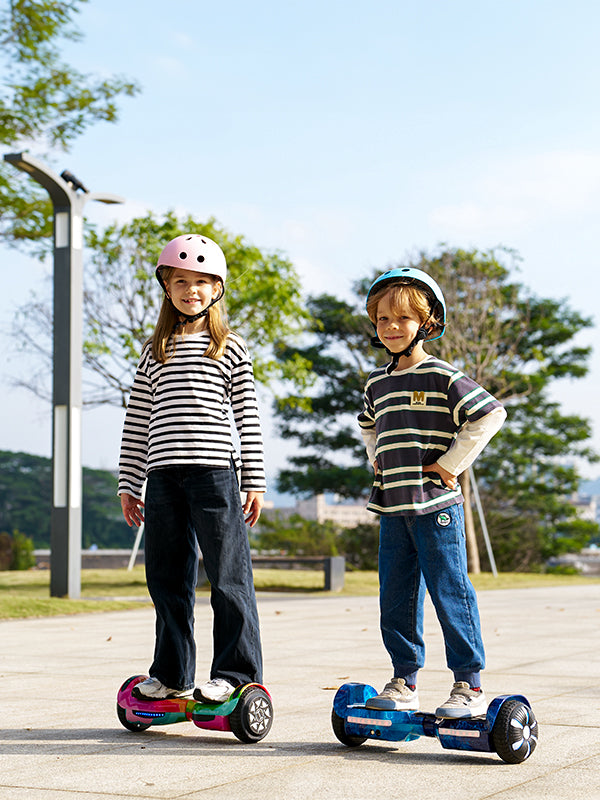
Independent safety organizations and international manufacturing guidelines generally agree on a standard baseline age to use hoverboard hardware safely. Across the European and British markets, the official recommended starting age is 8 years old. This benchmark isn't an arbitrary number pulled from thin air; it aligns directly with typical pediatric milestones regarding core stability and cognitive spatial awareness. By age eight, most children possess the rapid reaction times necessary to navigate sudden obstacles and the mental maturity to consistently follow safety rules, such as wearing a helmet without a massive household argument. Furthermore, the skeletal structure of an eight-year-old has developed the necessary resilience to withstand minor impacts and the ankle strength required to shift internal gyroscopes without suffering rapid leg fatigue. While chronological milestones offer a highly helpful starting point, evaluating your individual child's unique physical capability is the ultimate gatekeeper for safety. When deciding on the right age for hover board introduction, look closely at their performance on other classic outdoor balance toys like traditional micro-scooters, skateboards, or bicycles. A highly focused 7-year-old with exceptional core balance might be ready for a gentle backyard cruise, whereas an impulsive 9-year-old who struggles to pay attention to their surroundings might benefit from waiting a bit longer. Sifting through real-world trials and parent feedback across comprehensive iHoverboard News guides can help you accurately assess your child's readiness before hitting the purchase button. From my own testing logs, children who can ride a two-wheeled pedal bike without training wheels usually master a gyroscopic hoverboard inside of fifteen minutes. They already understand how subtle weight shifts translate to lateral movement, which prevents them from over-correcting and triggering a classic tip-over. The mechanical muscle tucked inside the wheel hubs dictates exactly how a self-balancing scooter handles under pressure. When determining a hoverboard for what age bracket is appropriate, you must analyze the relationship between motor wattage and rider payload. Entry-level 6.5-inch models generally run on smaller dual 150W or 250W motors, providing a smooth, highly manageable top speed that is ideal for younger learners. Conversely, heavy-duty 8.5-inch or 10-inch off-road variations feature high-torque dual 350W or 400W powertrains built to handle adult weight capacities over loose gravel and muddy grass. Giving a small child an overpowered adult deck can lead to jerky over-accelerations because their light frames cannot apply the smooth, nuanced footpad pressure these massive motors expect. To make matching hardware to a rider's developmental stage completely foolproof, iHoverboard organizes its catalog into explicit skill-level and structural tiers. Their kids' collection focuses on lightweight frames with restricted, beginner-friendly speed caps that let learners build confidence gradually. You can explore the entire premium selection within the iHoverboard Collections to find certified decks categorized specifically by wheel size and target user profiles. By offering adaptive training modes that damp down aggressive acceleration curves via internal gyroscopic limiters, iHoverboard ensures that finding the best age for a hoverboard upgrade remains safe, predictable, and stress-free for the entire family. If your child is finally ready to jump on a hoverboard, handing it over in a concrete driveway is a recipe for a quick tumble. To keep the initial learning phase safe, encouraging, and completely fall-free, walk them through this simple, step-by-step routine: Finding the perfect balance between high-tech entertainment and physical safety comes down to matching your rider's physical maturity with the correct mechanical framework. Sticking strictly to the industry-standard baseline of 8 years and older ensures that your family stays clear of painful sidewalk tumbles caused by underdeveloped coordination. By focusing your attention on automated self-leveling tech, appropriate wheel sizes, and robust weight minimums, you can turn a trendy tech gadget into a safe, reliable backyard adventure. Never sacrifice mechanical stability or clear age guardrails just to chase an ultra-cheap generic toy. Investing in established hardware that carries transparent certifications ensures that every afternoon spin stays entirely fun, predictable, and fully protected. Take the time to audit your child's balance on a bike or traditional scooter first, establish clear boundary rules for the pavement, and you will set your household up for years of safe, exciting outdoor exploration. No, medical professionals and major safety groups strongly discourage letting a 5-year-old ride a motorized hoverboard. At five years old, a child's bone density, joint growth plates, and core motor reflexes are still developing rapidly. Furthermore, a typical five-year-old does not weigh enough to reliably compress the internal weight sensors hidden underneath the rubber footpads. This lack of pressure causes the board to vibrate erratically or drop connectivity entirely, which can lead to sudden falls. If an older sibling or parent is introducing a child close to the age limit to a stationary board under direct, hands-on supervision, a standard 6.5-inch wheel size is the only appropriate platform. You should strictly avoid larger 8.5-inch off-road or 10-inch pneumatic options. The smaller 6.5-inch solid rubber tires offer a much lower deck height, ensuring that the rider's center of gravity remains close to the floor for maximum stability. Yes, ten years old is widely considered the absolute sweet spot for a child's first hoverboard. By age ten, children have developed exceptional spatial awareness, solid peripheral vision, and the physical leg leverage required to control a board easily. For a ten-year-old, you can confidently choose between a standard 6.5-inch commuter model or a larger 8.5-inch rugged frame if they plan to cruise over backyard turf or gravel pathways. A Note on Sensor Limits: Virtually all modern self-balancing scooters require a minimum rider weight of 44 pounds (approximately 20 kg) to fully engage the mechanical pressure switches beneath the rubber footpads. If a lightweight child falls below this critical baseline, the internal gyroscopes will struggle to compute their center of gravity accurately, which frequently causes the board to vibrate violently or fail to respond to steering inputs altogether. You can review the step-by-step solutions for managing these balancing mechanics inside our detailed Hoverboard Balance Sensor Troubleshooting Guide.Decoding the Official Safety Regulations for Hoverboard Age Limits
Is Your Child Ready? Finding the Right Age for Hoverboard Fun
Testing Motor Strengths: Hoverboard For What Age Group Matters Most?
iHoverboard Skill-Level Classifications Demystified
How to Guide Your Child’s Very First Ride (Without the Tears)
Setting Your Family Up for a Secure, Worry-Free Journey
Frequently Asked Questions
Can a 5 year old ride a hoverboard?
What size hoverboard for a 5 year old?
Should I get my 10 year old a hoverboard?





Still, need help? Contact Us: support@ihoverboard.com
What's the option? Check out the option now!
Leave us a message