


















How Much Difference Does an Off-Road Hoverboard Make on Big Obstacles?
Riding a standard urban self-balancing board over polished hardwood or smooth sidewalks is effortless, but taking those small 6.5-inch wheels into the backyard, across gravel driveways, or over park trails usually ends in a sudden halt. Small wheels simply lack the ground clearance and tire volume required to clear everyday outdoor hazards. That is where an off-road hoverboard completely changes the game. By stepping up to larger wheel frames—such as an 8.5 inch hoverboard like the heavy-duty iHoverboard H8Max Off Road Hoverboard or a 10 inch hoverboard—riders gain the clearance, motor torque, and traction needed to glide over obstacles that would stop a city board in its tracks. In this guide, we explore the mechanical differences that allow large-wheel all-terrain hoverboards to roll over bumps, grass, and rough terrain, while comparing tire configurations, steering dynamics, and battery performance. When evaluating large-wheel boards built for rougher terrain, tire construction plays a major role in how the vehicle absorbs shocks and maintains grip. Off-road balance boards generally utilize two main tire types: solid treaded rubber and air-filled pneumatic tires. Models like the iHoverboard H8Max feature wide 8.5-inch solid rubber tires equipped with deep anti-skid treads. A 10 inch off road hoverboard frequently utilizes inflatable pneumatic inner-tube tires. Parents often worry whether upgrading to a heavy-duty 10 inch all terrain hoverboard or a wide-wheel 8.5-inch board will make steering too difficult for younger kids or lighter teenagers. While larger boards are inherently heavier due to reinforced metal chassis and high-wattage dual motors, modern balance technology makes controlling them surprisingly intuitive: For younger kids, an 8.5-inch model like the iHoverboard H8Max offers an ideal middle ground—delivering rugged off-road stability while remaining lighter and easier to carry than massive 10-inch boards. The real test for any hoverboard off road 10 inch or 8.5-inch model is how effortlessly it tackles real-world outdoor hazards. The combination of elevated ground clearance and wide tire profiles dictates how smoothly you roll over challenging surfaces. Standard 6.5-inch wheels sink into thick grass, causing the chassis to drag and the motors to stall. By contrast, an 8.5 inch hoverboard or 10-inch board elevates the chassis roughly 2 to 3 inches above the ground, allowing the high-torque treaded tires to bite into the dirt underneath without chassis resistance. Riding over loose stones on small solid tires can cause the board to slip or jitter uncomfortably. Wide off-road tires disperse weight over a larger surface area, rolling across packed gravel and forest soil with minimal slipping. When hitting a 1-inch root or pavement gap, a larger wheel contacts the obstacle at a shallower angle. This enables the wheel to climb right over the bump instead of abruptly stopping forward momentum. Feature / Metric Standard 6.5-Inch Hoverboard iHoverboard H8Max (8.5-Inch) 10-Inch All-Terrain Hoverboard Primary Terrain Smooth asphalt, tiles, indoor floors Grass, gravel, dirt tracks, park paths Deep grass, mud, rough trail obstacles Tire Construction Slim solid rubber Wide 8.5" anti-skid solid rubber 10" Inflatable pneumatic tires Ground Clearance ~1.0 inch ~2.2 inches ~3.0 inches Obstacle Capability Minor cracks only Roots, grass, packed gravel Large roots, deep grass, uneven terrain Maintenance Need None Low (Puncture-proof) Moderate (Check tire PSI regularly) Upgrading wheel size affects not only terrain capability, but also mechanical gear ratios, top speed potential, and battery power consumption. Because a 10-inch or 8.5-inch tire has a larger outer circumference than a 6.5-inch tire, every full rotation of the motor covers significantly more distance. Consequently, off-road boards comfortably achieve higher top speeds—typically reaching 12 to 15 km/h (7.5 to 9.3 mph) while keeping motor RPMs smooth and controlled. Rolling over soft grass, mud, and steep inclines requires dual brushless motors to output higher peak wattage (often 700W to 800W combined). Because the motors work harder to push through soft terrain, riding off-road uses roughly 20% to 30% more energy than cruising across smooth pavement. Selecting a model with high-grade lithium battery protection ensures consistent power output even during demanding trail climbs. For riders looking for the best 10 inch hoverboard or 8.5-inch off-road option, balancing tire type, frame weight, and motor wattage guarantees an thrilling outdoor riding experience. Upgrading to an off-road hoverboard makes a massive difference when taking your ride beyond paved streets. Whether navigating thick backyard grass, packed gravel paths, or uneven forest trails, larger wheel profiles elevate ground clearance and prevent the chassis from getting hung up on obstacles. While air-filled 10-inch models offer plush shock absorption, 8.5-inch models like the iHoverboard H8Max combine puncture-proof solid tire reliability with high-torque dual motors, robust alloy mudguards, and integrated Bluetooth music streaming. Ready to conquer bigger outdoor obstacles? Explore our full range of all-terrain off-road hoverboards today! Yes. If your off-road hoverboard features pneumatic (air-filled) tires, you should check tire pressure every few weeks to ensure they remain inflated between 30 and 35 PSI. Maintaining correct inflation prevents pinch flats, improves battery range, and protects the wheel rims from damage when rolling over sharp bumps. Not necessarily, but age and weight guidelines should be checked. Most 8.5-inch off-road hoverboards like the iHoverboard H8Max feature automatic self-balancing technology that makes mounting easy. However, because off-road boards weigh more than basic models (typically 10 to 12 kg), riders should weigh at least 20 to 25 kg (44–55 lbs) so their movements properly register on the internal gyro sensors. Off-road hoverboards are built to handle damp ground and light morning dew on grass thanks to water-resistant chassis sealing (typically IP54 rated). However, you should never submerge the board or ride through deep standing puddles to avoid water damage to the battery and electric motors.
Pneumatic Tires vs Solid Rubber on Off-Road Wheel Frames
1. Solid Treaded Rubber Tires (Common on 8.5-Inch Off-Road Models)
2. Inflatable Pneumatic Tires (Common on 10-Inch All-Terrain Models)
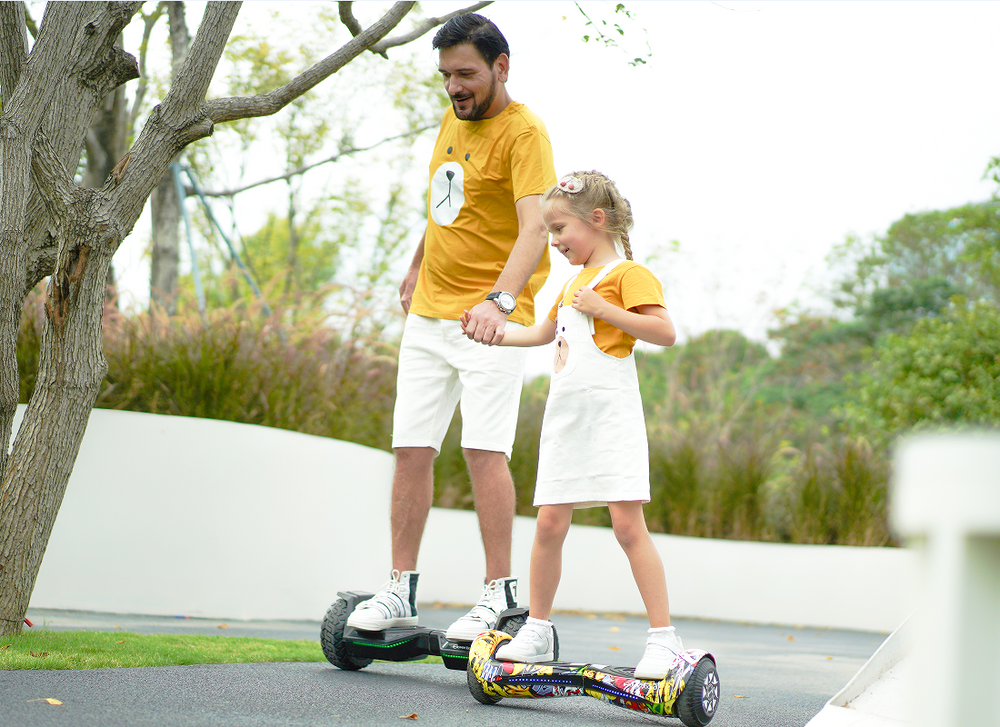
Are Large-Wheel Hoverboards Easy for Younger Riders to Steer?
Outdoor Obstacle Navigation: Bumps, Grass, and Gravel
1. High Lawn Grass and Meadow Trails
2. Loose Gravel and Unpaved Paths
3. Curb Lips, Potholes, and Tree Roots
How Wheel Size Impacts Top Speed and Battery Strain
Speed Capabilities
Battery Consumption and Motor Torque
Conclusion
Frequently Asked Questions
Do inflatable hoverboard tires require regular pressure checks?
Is an off-road hoverboard too large for younger kids to operate safely?
Can an off-road hoverboard be ridden on wet grass or through puddles?






Still, need help? Contact Us: support@ihoverboard.com
What's the option? Check out the option now!
Leave us a message